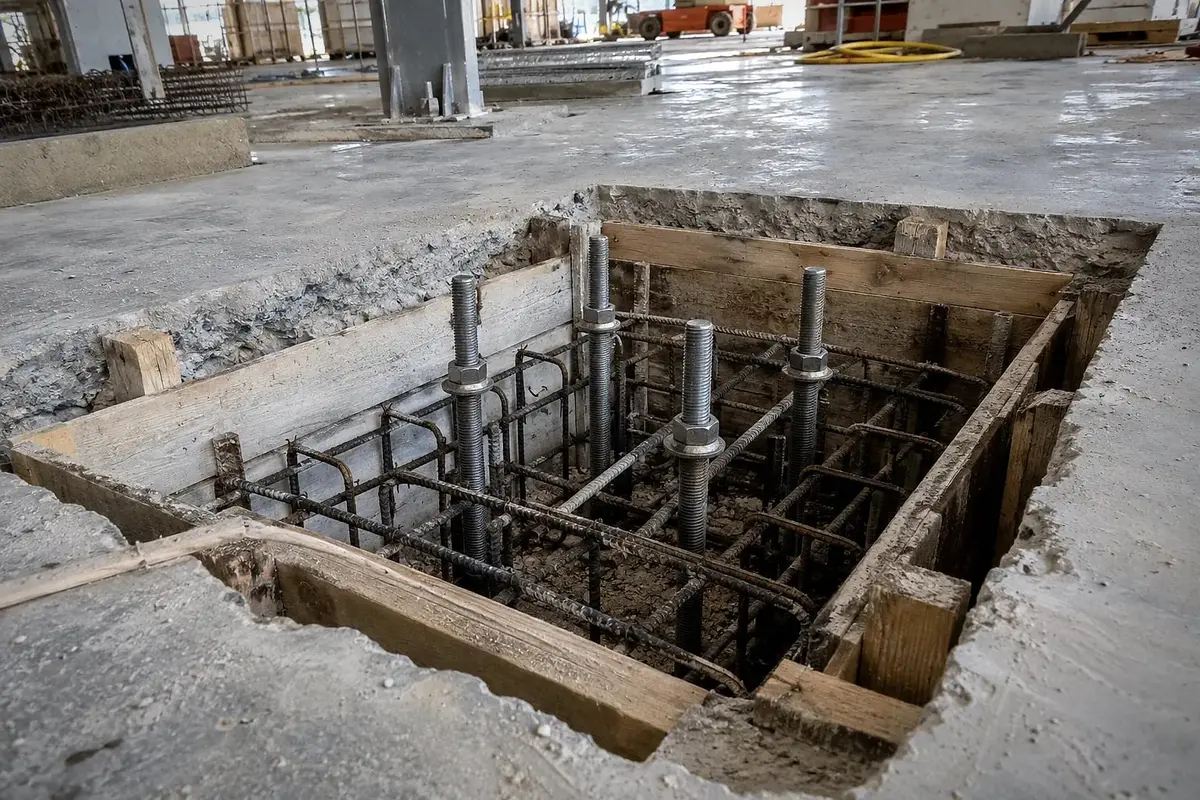
Installing an industrial mezzanine involves taking many technical and regulatory constraints into account. Building a concrete pad foundation is one of them. It is a reinforced concrete structure whose role is to improve the stability of the industrial mezzanine. The ability of the mezzanine to carry heavy loads is a key factor in its design, and a concrete pad foundation is a major asset in this respect. These civil engineering works require careful planning and specific knowledge, both technical and legal or administrative.
In this article, we cover in detail everything you need to better understand what such a project means for your industrial mezzanine.
When do you need a concrete pad foundation for your mezzanine?
A concrete pad foundation is not always required for every industrial mezzanine, but it may be necessary whenever the stability of the structure must be guaranteed over the long term:
- When the industrial mezzanine has to carry heavy loads
- When the ground is not suitable
- To comply with specific safety standards
If your industrial mezzanine is intended to carry significant loads (heavy machinery, large stocks, etc.), a concrete pad foundation will be essential to strengthen its structure, and so guarantee its stability despite the weight of the loads.
The ground may also need to be strengthened beforehand so that it can carry the weight of the industrial mezzanine. A concrete pad foundation can be the right answer, spreading the loads more evenly and avoiding any risk of the ground subsiding or deforming under the pressure of the mezzanine columns.
Finally, a concrete pad foundation is an essential solution to guarantee the structural stability of your industrial mezzanine in all circumstances, and so to comply with the safety standards specific to your sector.
The soil survey: a step not to overlook
Any concrete pad foundation requires a prior soil survey. This step is essential to determine the nature of the ground on which the industrial mezzanine will be installed, and so to identify any strengthening work that must be carried out beforehand.
A geotechnical survey is carried out by a specialist firm. It involves taking and analysing soil samples to assess the composition and bearing capacity of the ground, and to determine the depth of the water table. This geotechnical survey is an essential prerequisite for defining the technical characteristics of the concrete pad foundation.
A soil survey helps anticipate the risks associated with installing an industrial mezzanine. The main one: ground that subsides or deforms and ends up damaging the structure.
A soil survey is an additional cost that must be taken into account (experts travelling to the site), but it avoids unexpected expenses later on. It also lets you size the concrete pad foundation precisely for your actual needs, and so optimise its construction cost.
What legal aspects apply to adding a concrete pad foundation?
Adding a concrete pad foundation to the structure of an industrial mezzanine is a construction project that raises legal and administrative questions. It is essential to know the standards and regulations in force to make sure that the work fully complies with them. The points below concern French regulations.
Compliance with the French Planning Code
Building an industrial mezzanine with a concrete pad foundation requires a building permit. Under the French Planning Code, a building permit application is required for any construction with a floor area of more than 20 m².
Compliance with current safety standards
French regulations impose strict safety standards for industrial buildings. These standards concern in particular fire resistance, stability and the ability of the structure to guarantee the safety of the people who will use it in their work. Adding a concrete pad foundation must therefore ensure compliance with these safety standards, so that the industrial mezzanine fully complies with the law.
Civil liability and ten-year liability
In France, every construction project engages the civil and professional liability of the company that builds it. The ten-year guarantee (garantie décennale) makes the contractor liable for 10 years for any damage that compromises the soundness of the construction. Under this liability, the company that carried out the works must pay for repairs if there is a problem with the concrete pad foundation.
All these legal obligations call for particular rigour in carrying out this type of work. Appropriate support from qualified professionals is essential to ensure that the project complies.
Insurance against damage: what you should know
As with any construction, damage may occur after a concrete pad foundation has been built (arson, sabotage of the structure, etc.). To protect yourself against these risks, you need suitable insurance, such as building damage insurance or comprehensive business insurance.
Building damage insurance
This insurance covers repair costs in the event of a claim affecting the soundness of the industrial mezzanine or the concrete pad foundation. It guarantees that repair work is paid for quickly, without having to wait for the exact responsibility for the damage to be established. In France, building damage insurance (dommages-ouvrage) must be taken out before construction begins.
Comprehensive business insurance
This insurance covers the industrial mezzanine, as well as the goods and equipment on it, in the event of damage caused by a failure of the concrete pad foundation.
Do you have a project? Request a free quote: our engineering office studies your building and proposes the right solution.